"Just Do..."
The Most Toxic Phrase in Math Education
by David Henson M.Ed.
June 2026
Honestly, we have all probably said some variation of these statements. Whether it was born from a place of frustration, a ticking clock, or simple expediency, we made the choice to teach a math trick instead of the messy, beautiful reality of building conceptual understanding.
Each time, some version of “Just do” led the way. But we need to be honest about the cost of that shortcut. “Just do” ends student curiosity. “Just do” ends student creativity. It is toxic to a student’s drive for problem-solving.
But how exactly is it toxic? Research into classroom dynamics gives us a sobering look at what happens to a child’s brain when we replace "Why?" with "Just do."
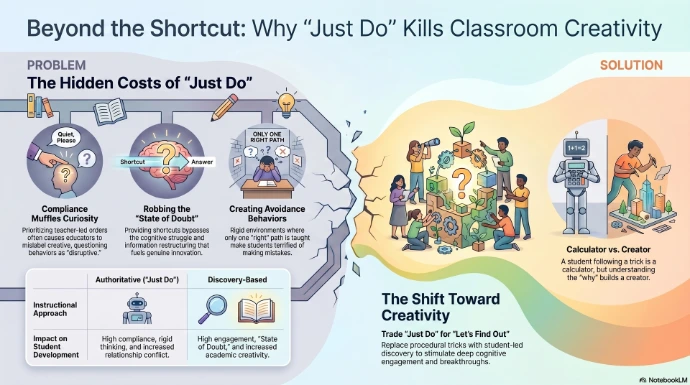
1. Just Do Replaces "Discovery" with "Compliance"
When we say "Just do," we shift the goalpost. The objective is no longer to understand the logic of the universe; it’s to follow the teacher's orders. Research (Ahmad & Hashmi, 2025) shows that when we prioritize compliance, we accidentally label creative, questioning behaviors as "disruptive."
When a student asks, "But why does the fraction flip?" and we respond with "Just do it this way for the STAAR test," we aren't just teaching math—we are teaching them that their divergent thinking is an obstacle to success. Over time, students stop asking "Why?" and start asking "What do I need to do to pass?"
2. Just Do Robs Students of the "State of Doubt"
Creativity isn't a lightning bolt; it’s a response to a problem. It is fueled by what researchers call a "state of doubt." When a student is confused, their brain is primed to restructure information and find a creative way through the fog.
“Just do” is a premature resolution. By giving the trick before the struggle, we bypass the very cognitive engine that drives innovation. Studies on problem-solving pedagogy (Zhan et al., 2024) confirm that teacher-determined solutions are significantly less effective at stimulating creativity than student-discovered ones. When we provide the shortcut, we steal the breakthrough.
3. Just Do Imposes a "Rigid Atmosphere of Authority"
The TEKS Mathematical Process Standards explicitly call for students to communicate mathematical ideas, display reasoning, and justify their answers. But "Just do" implies there is only one "right" path—the one the teacher paved. This creates a rigid environment where students become terrified of making a mistake.
Research suggests that when classrooms are dominated by these "authoritative" instructional methods, students develop avoidance behaviors. They stop experimenting because any deviation from the "Just do" instruction feels like a failure. In this climate, the "messy reality" of learning is replaced by a sterile, low-risk, and ultimately low-creativity routine.
4. Just Do Breeds Relationship Conflict
We might think a quick "Just do" is a harmless time-saver, but it can actually damage the teacher-student bond. Research highlights that while intellectual conflict (disagreeing over an idea) can spark creativity, relationship conflict (feeling unheard or shut down by a teacher) actively suppresses it (Xie & Jiang, 2022).
When a student’s curiosity is met with a "Just do," they feel dismissed. That dismissal breeds a lack of engagement, and without engagement, creativity dies on the vine.
Instead of Just Do: What to Say Tomorrow
To break the habit, we need go-to responses for those moments when we feel the urge to rescue a struggling student with a shortcut. Try these instead:
"What do you notice about this problem?"
"Can you prove to me why that step works?"
"What would happen if we tried doing this backward?"
The Messy Way Forward
The next time the "Just do" reflex starts to take over, we have to remember the research. The math trick might get them through the worksheet today, but it won't help them solve the problems of tomorrow.
We have to embrace the mess. We have to allow for the "state of doubt." We have to trade the "Just do" for a "Let’s find out."
" Because a student who follows a “trick” is a calculator, but a student who understands the "why" is a creator. "

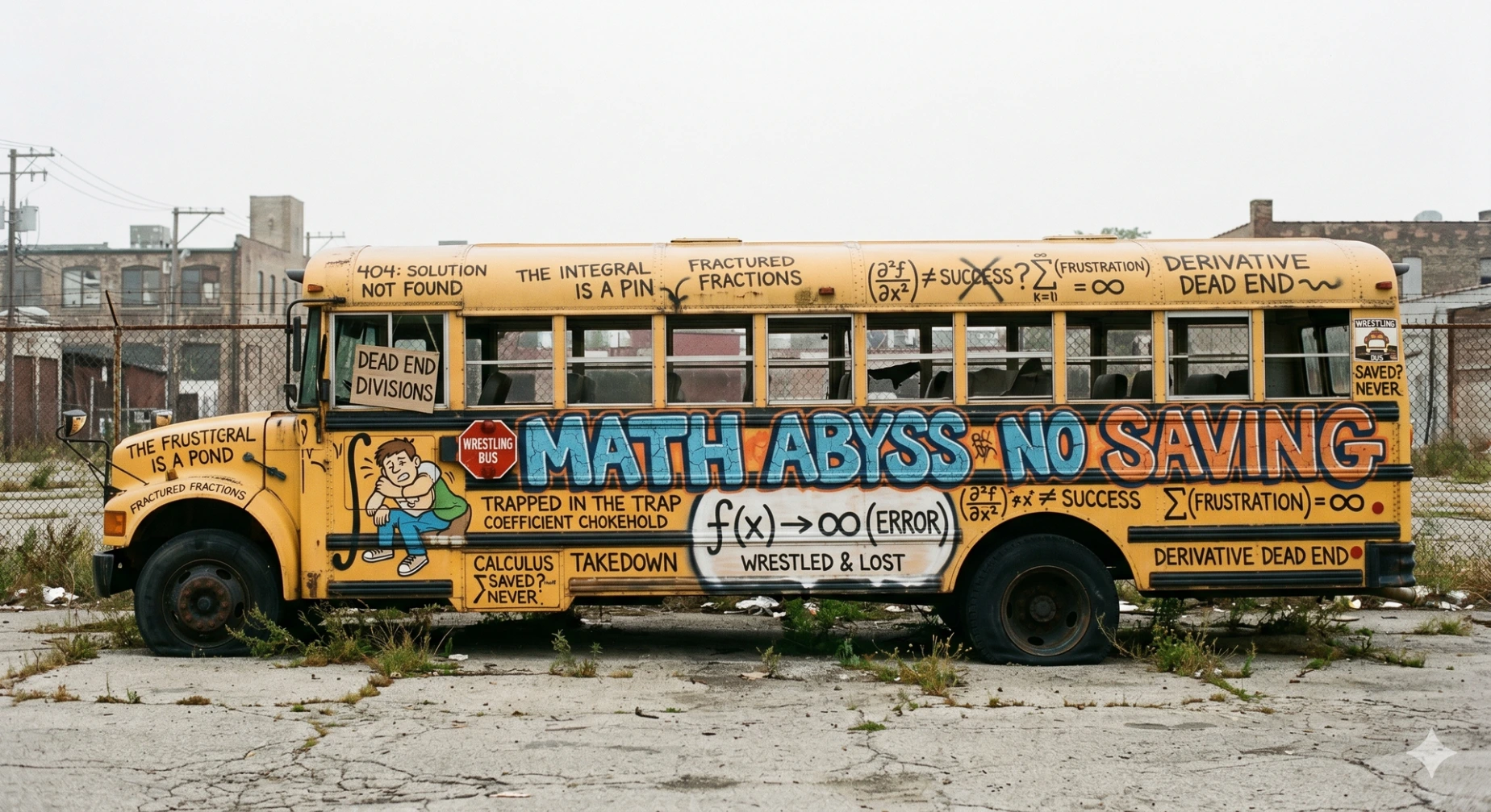
No Math Gets Saved From the Wrestling Bus
Sources Cited
Ahmad & Hashmi (2025): Impact of Disruptive Behavior on Academic Creativity of Secondary School Students.
Zhan et al. (2024): How does problem-solving pedagogy affect creativity? A meta-analysis of empirical studies.
Xie & Jiang (2022): Creativity: The Effectiveness of Teacher-Student Conflict.