Productive Struggle has Bad Branding
(and what we should call it instead)
by David Henson M.Ed.
June 2026
Let’s be honest: no one likes to struggle.
In polite society, it feels downright wrong to stand by and deliberately watch someone flail through a task that you could easily solve for them. Our natural human instinct is to help.
This instinct is amplified tenfold for teachers. Educators wake up every single day with a core mission: to invest in their students and help them succeed. So, when a teacher sees a student stuck on the metaphorical "struggle bus," the urge to rush in and rescue them is almost overwhelming.
But in math education, that well-intentioned rescue can actually derail true learning.

The Problem with "Productive Struggle"
The National Council of Teachers of Mathematics (NCTM) explicitly defines Productive Struggle as students pursuing tasks “more deeply into understanding the mathematical structure of problems and relationships among mathematical ideas, instead of simply seeking a correct solution.”
According to developmental psychologist Jean Piaget, this requires students to operate in a state of disequilibrium—the uncomfortable mental friction that happens when you try to apply your prior knowledge to a brand-new, novel situation.
To foster this environment, teachers have to let students toil away at a problem without stepping in with a major intervention. But because "struggle" sounds so inherently negative, it invites a rescue mission.
The phrase has a branding problem. If a student says, "I'm struggling," it sounds like a cry for help. It signals to the teacher that it’s time to save them.
Time for a Rebrand: Enter "Math Wrestling"
What if we stopped calling it a struggle and started calling it a match? What if we ask our students to wrestle with the math instead?
Wrestling with a task means having to deal with, understand, and solve difficult problems. It demands intense mental effort, time, and serious perseverance. It’s a sustained, sometimes frustrating battle to overcome obstacles and figure out a solution.
Think about the psychological shift that happens when we change that one word:
When someone says: "I am struggling with this problem." → It implies helplessness and invites outside intervention.
When someone says: "I am wrestling with this problem." → It implies determination. It assumes the person is actively engaged and fighting to work through it independently.
Crucially, no one wants to rescue a wrestler. When you watch a wrestling match, you expect to see a battle of strength and wit. You don't jump onto the mat to save them; you watch them work to pin their opponent.
Step Off the Struggle Bus
By shifting our vocabulary from "productive struggle" to "Math Wrestling," we can completely transform a student's perception of success and a teacher's expectation of when to intervene.
We can raise student expectations simply by renaming the challenge. We want our students—and society as a whole—to see mathematics less as a hardship to be rescued from, and more as an opponent to be wrestled into submission.
It’s time for kids to step off the struggle bus and onto the math wrestling bus. Because no one feels the need to save a wrestler!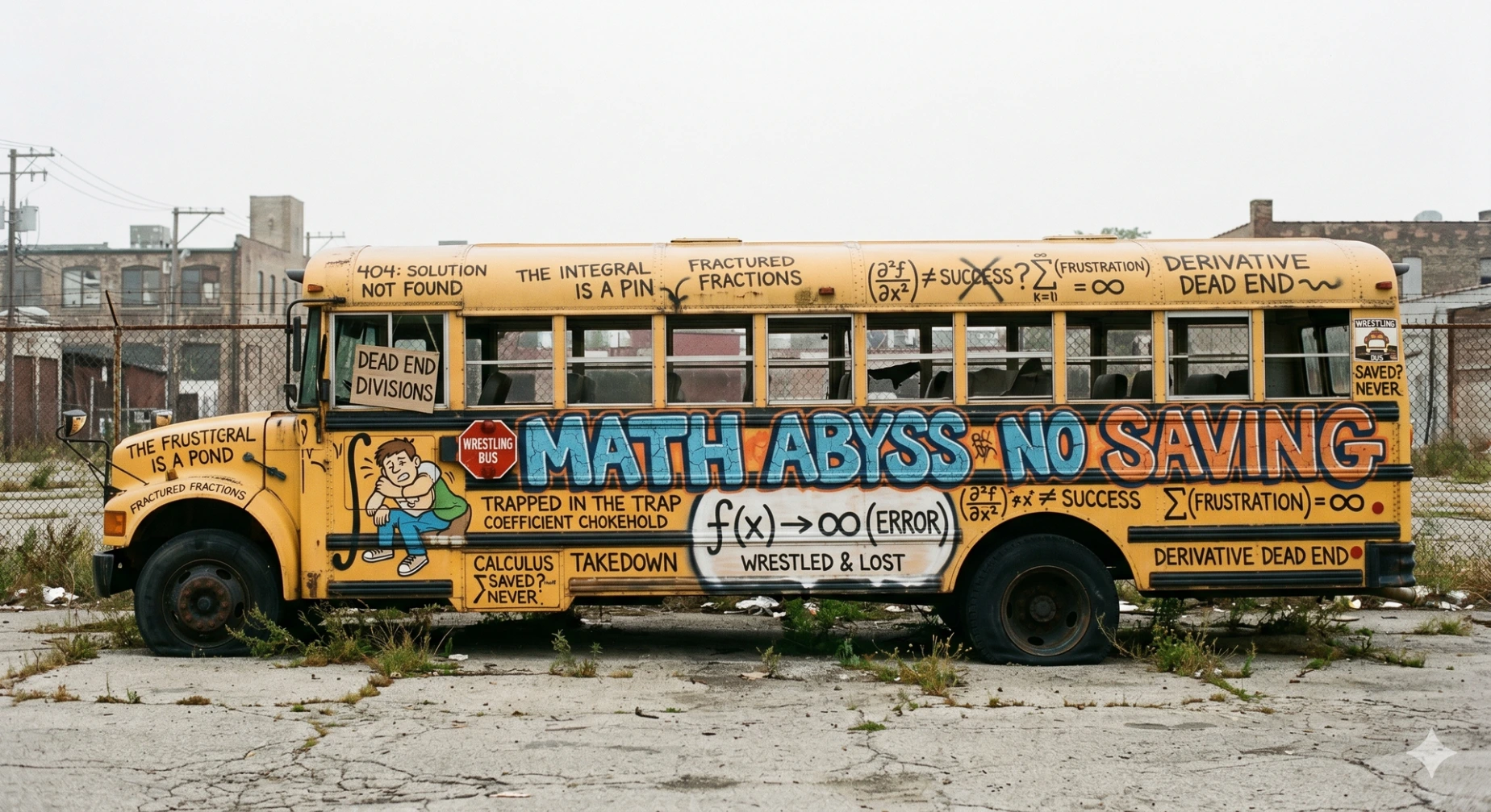
Sources Cited
National Council of Teachers of Mathematics. (2014). Principles to actions: Ensuring mathematical success for all. National Council of Teachers of Mathematics.
Note on Piaget: Jean Piaget's concept of disequilibrium (the cognitive conflict that occurs when new information doesn't fit existing mental schemas) is a foundational theory in developmental psychology rather than a single specific paper, but it serves as the conceptual backbone for the NCTM's definition of productive struggle.