Scouting Report: CRA Conceptual Learning Model
by David Henson M.Ed.
July 2026
Idea/Innovation Name: Concrete–Representational–Abstract (CRA) Conceptual Learning Model
Pedagogical Pivot:
CRA is an explicit instructional framework where students move through three phases of learning:
Concrete – Manipulating physical objects to model mathematical relationships
Representational – Drawing or visually representing those relationships
Abstract – Solving problems using mathematical symbols and equations
The "Elevator Pitch":
Instead of jumping straight to abstract formulas, students build conceptual understanding through a “build it” → “sketch it” → “solve it” structured scaffolding.
The Impact:
Research shows CRA significantly improves mathematics performance for students with learning difficulties and those at risk for failure.
Scout’s Rating:
⭐ ⭐2 Teacher Readiness for Implementation
⭐⭐⭐ Student Resilience in Problem Solving
Note: Concrete-Pictorial-Abstract (CPA) and CRA both have their roots in Bruner’s Three Modes of Representation: Enactive, Iconic, Symbolic. Reading materials on both CPA and CRA has led this author to believe there is little difference in the two methods.
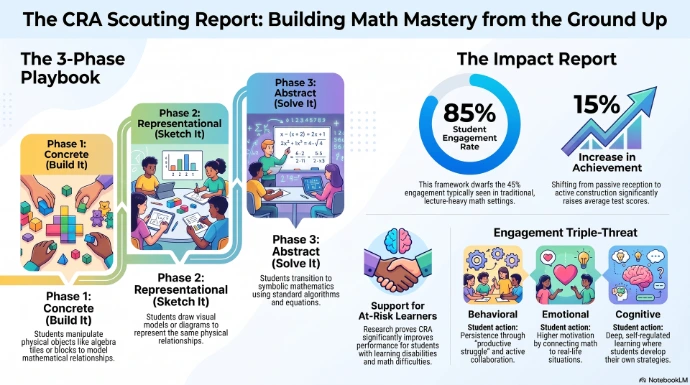
The Scouting Report: Why CRA Modelling Works
- Pedagogical Pivot: This sequence eliminates the "math anxiety barrier" by providing a concrete entry point for students who struggle with the pure, naked notation of numbers.
Target Audience: Primarily K–12 mathematics, with particularly strong research support for:
Students with learning disabilities
Students at risk of mathematics failure
Intervention settings
Algebra readiness
Mechanics: Concrete–Representational–Abstract instruction follows a structured progression.
Concrete Stage
- Students manipulate physical objects (counters, algebra tiles, base-ten blocks) to represent mathematical relationships.
Representational Stage
- Students draw models of the same concept.
Abstract Stage
- Students transition to symbolic mathematics.
Ideal Plan in a Perfect Classroom: Explore, Explain, Elaborate
What Usually Happens in “That" Class”: “Teacher! I don’t know what to dooooo!” repeated at random times throughout the room
Research by Witzel, Mercer, and Miller (2003) demonstrated that students with learning difficulties who learned algebra using a CRA-based explicit instruction model significantly outperformed peers receiving traditional symbolic instruction. Similarly, Flores (2010) found that students at risk for mathematics failure showed substantial improvement in subtraction with regrouping when taught through a CRA sequence.
The Coach’s SWOT Analysis of CRA Modelling
- Strengths: High cognitive clarity. Using real-world physical models or tactile experiences limits what a student can do incorrectly. The physical constraints of the real world enforce the mathematical laws automatically before symbols are introduced.
- Weaknesses: High risk of "procedural mimicry." If a teacher treats the physical or visual steps like a rigid recipe (e.g., "Step 1, put this here; Step 2, draw a circle there"), students simply mimic the motions without connecting them to the actual mathematical concept.
- Opportunities: This is an elite framework for correcting deep-seated misconceptions. For example, when comparing fractions or decimals, using the visual and concrete stages on a clothesline breaks the habit of "whole-number thinking" (e.g., thinking 0.15 must be larger than 0.2 because 15 is bigger than 2).
- Threats: The "Toy Trap." Without strict routines and explicit connections to the Representational and Abstract stages, the concrete materials become an expensive distraction rather than an instructional accelerator.
How CRA Wins: Targeted Use
To successfully execute CRA across your curriculum, you don't need to rewrite your entire scope and sequence overnight. Instead, run this targeted, step-by-step play to ground your next high-stakes concept:
First Action Item: Find your mathematical “Hill,” a single concept that you feel is foundational for students to be successful on subsequent topics. Start your CRA planning right here.
Check the Math Closet: In every school, there is a closet filled with math manipulatives that will perfectly anchor your Concrete phase. If you teach middle or high school, you may have to deal with a significant layer of dust on top of the bins.
More Than One Representation is Allowed: Don't box yourself into just one drawing. Having a second, non-aligned visual representation in your playbook before students progress to the Abstract stage is highly encouraged. Tiering your visuals—having one representation that sits closer to the Concrete experience and a second that bridges closer to Abstract notation—helps students transition far more naturally.
Pro-Tips: If I use the CRA Model...
- Keep the manipulatives handy: Never take the physical models away cold turkey. When moving from Concrete stage to Representational stage, keep the physical references available in the room. Offer for students to look at the physical layout while they draw their representation.
- Room design: This requires flexibility for movement. Arrange student desks in "shoulder partner" pairs or small pods so students can collaborate on physical tasks and share workspace easily without losing instructional time.
- Consider who is doing what: To prevent one student from doing all the physical modeling while peers passively watch, assign specific roles: one student acts as the Builder (handling the physical setup), one acts as the Architect (drawing the representational sketch), and one acts as the Scribe(writing down the abstract notation). Rotate roles for every problem to keep everyone in the game.
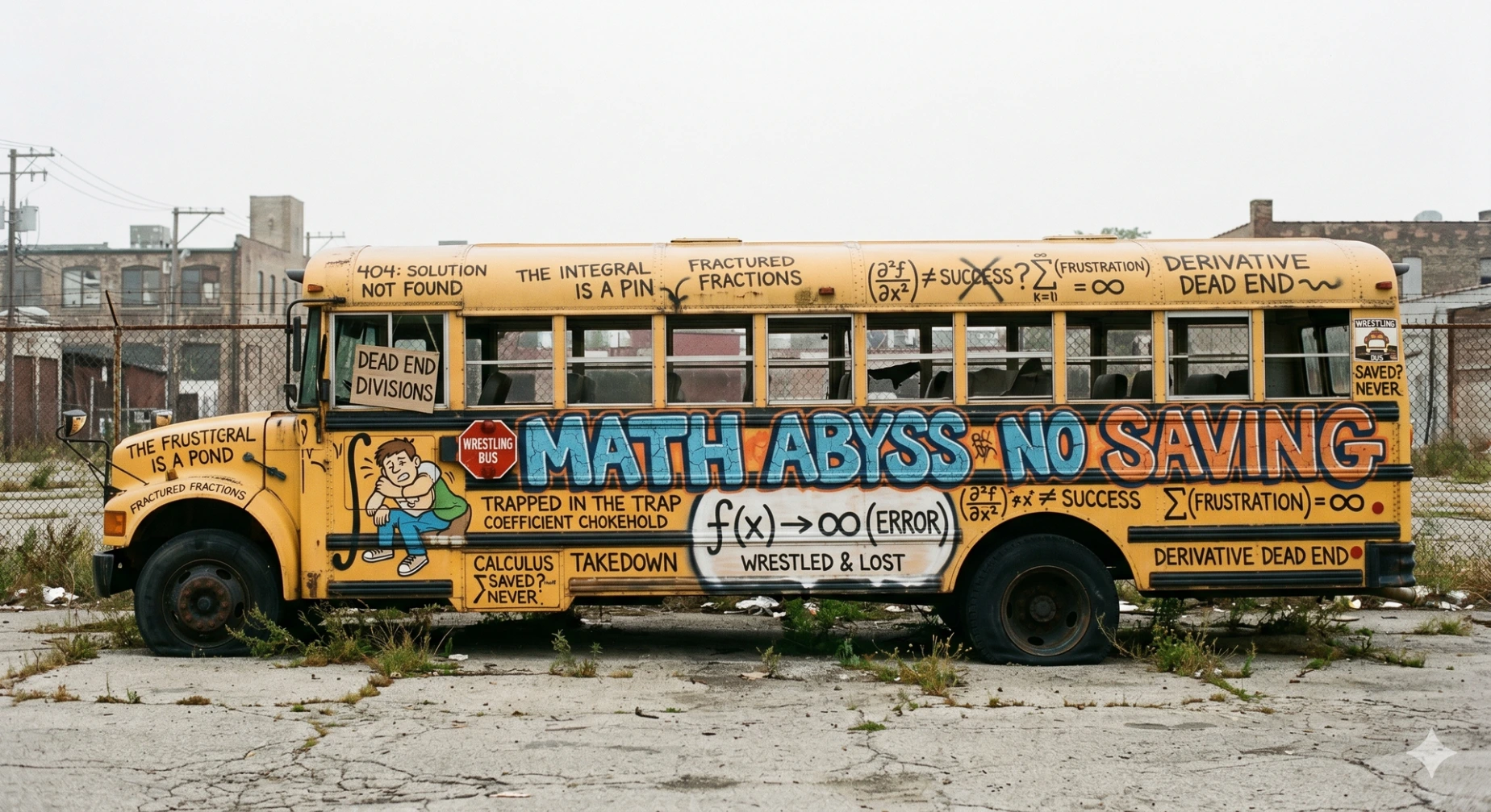
No Math Gets Saved From the Wrestling Bus
Sources Cited
- Bruner, J. S. (1966). Toward a theory of instruction. Harvard University Press.
- Flores, M. M. (2010). Using the concrete-representational-abstract sequence to teach subtraction with regrouping to students at risk for failure. Remedial and Special Education, 31(3), 195–207.
- Witzel, B. S., Mercer, C. D., & Miller, M. D. (2003). Teaching algebra to students with learning difficulties: An investigation of an explicit instruction model. Learning Disabilities Research & Practice, 18(2), 121–131.