Scouting Report: Explicit Instruction
by David Henson M.Ed.
June 2026
- Idea/Innovation Name: Explicit Instruction (EI).
- Pedagogical Pivot: EI is a systematic, structured approach where the teacher guides students through the learning process with clear explanations, modeling, and practice.
- The "Elevator Pitch": We’re moving from "all-information-starts-here" to "here-is-the-path." EI prioritizes clarity and cognitive load management over open-ended exploration.
- The Impact: Research suggests that for students with learning difficulties, intervention, or when introducing highly abstract concepts (like the Laws of Exponents), EI can reduce frustration and accelerate mastery.
- Scout’s Rating: * ⭐⭐⭐⭐ Teacher Readiness for Implementation
- ⭐⭐ Student Opportunity for Independent Discovery
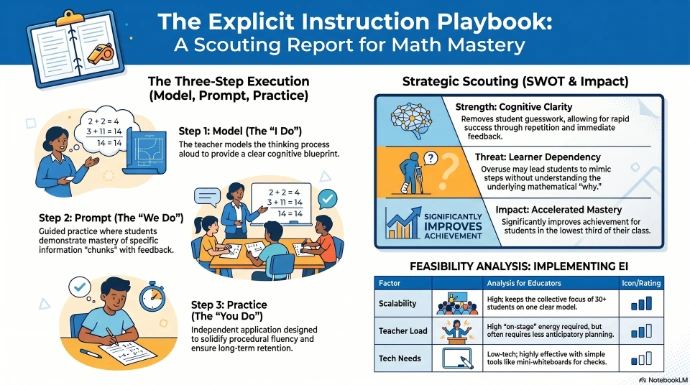
The Scouting Report: Why Explicit Instruction Works
Pedagogical Pivot: This method addresses the "barrier to entry" for students who lack the prior knowledge to engage in productive struggle.
Target Audience: Pre K-12 & Higher Ed.
Mechanics: Explicit Instruction in mathematics is a teacher-led pedagogical approach that begins with a clear objective and a "hook." It follows a structured sequence: modeling (Model), guided practice (Prompt), and independent practice (Practice). By breaking down complex skills into manageable "chunks," it minimizes the effect of cognitive overload. As a math coach, I view this as giving students the "blueprint" before asking them to build the house.
Ideal Plan in a Perfect Classroom: Model, Prompt, Practice.
What Usually Happens in “That Class”: “Wait, what was step two?” with the student waiting until the teacher redirects or the heat death of the universe, whichever happens first.
The Coach’s SWOT Analysis of Explicit Instruction
Strengths: EI provides Cognitive Clarity. It removes the "guesswork" and allows students to feel successful quickly by mastering specific skills through repetition and feedback. Teachers can utilize their own experience of Direct Instruction as a framework for EI. Where Direct Instruction likes to present all new content upfront, EI likes to arrange the content into smaller packages in order to minimize cognitive overload.
Weaknesses: It can lead to Passive Compliance. If overused, students may become "mimics" rather than "mathematicians," learning how to follow steps without understanding the why. Likewise, packaging content can prove difficult due to cognitive overload that looks different from student to student. The teacher must have strong formative checks in order to monitor readiness for the next step/concept. This potential overreliance on the teacher can lead to student attributes that are habitual to a Dependent Learners (Hammond 14)
Opportunities: Research indicates that EI has dramatic benefits to students identified with learning disabilities and/or requiring math intervention. EI, in conjunction with Concrete-Representational-Abstract sequence of math instruction, has demonstrated repeated boosts in math performance and retention of concepts. (Bjorkhammer et al.)
Threats: The primary threat is Learner Dependency. (Hammond 14) If students are always told exactly what to do, they may struggle when faced with a "messy" real-world problem that doesn't fit the modeled template.
How Explicit Instruction Wins: Targeted Use
Don't use EI for every lesson, but be strategic with it. Use EI as a to set up for Inquiry. Productive struggle is no longer "productive" when mastery of math fundamentals is at risk.
First Action Item: Identify a "bottleneck" concept where students consistently struggle. Prepare a 10-minute "I Do" that models the thinking process aloud (Metacognition).
Risk Level: Low risk of chaos; Moderate risk of "zoning out." Keep your modeling sessions "short and punchy".
Personal Take: There are some things in math that “discovery” methods only allow you to discover you can’t do them. EI should be used in concert with Inquiry-based Instruction to maximize student learning.
Pro-Tips: If I use Explicit Instruction...
Be Strategic: Use EI in concert with Inquiry. In the course of unit planning, leverage the strength of EI for introduction of concepts and Inquiry Instruction for the ability to elaborate and expand on prior knowledge. Blending both strengths has definite advantages to the support of fact fluency as well as support student independence of learning.
Room Design: Unlike Inquiry, this method works well with traditional rows or a "theatre" setup where all eyes are on the lead instructor. A modification to traditional rows would be a “shoulder partners" set up. Pairs of desks to facilitate quick shoulder partner conversations without movement.
Consider Engagement: Every class has a “Heavy Lifter” student. That one (or two) student that has an answer for every question. To ensure one student isn’t answering while thirty watch, use mini-whiteboards or math discussion routines to keep everyone in the game.

No Math Gets Saved From the Wrestling Bus
Sources Cited
Hammond, Zaretta. Culturally Responsive Teaching and the Brain: Promoting Authentic Engagement and Rigor Among Culturally and Linguistically Diverse Students. Corwin, 2015.
Björkhammer, C., Hedman, M., Krey, A., Samuelsson, J., Träff, U., & Östergren, R. (2025) Effects of a fraction intervention for students with special educational needs in mathematics. Scandinavian Journal of Educational Research. Published online: Sept. 3, 2025