Ticket to Success
Algebra and Beyond
A hands-on workshop that turns the humble exit ticket from a grading chore into your most powerful diagnostic tool — so every teacher leaves with a formative assessment routine they can run Monday morning.
Contact us minutes, fully facilitated
180
exit-ticket archetypes
4
tickets designed by each teacher
2
minute 3-Pile Sort routine
8-10
Why this matters
Data alone doesn't improve learning. Acting on it does.
The session is built on the formative instructional loop: a simple, four-step flight plan teachers can run at the end of any lesson. Exit tickets are framed as diagnostic, not grading — low-stakes for students, high-leverage for instruction.

Establish target
Define a precise, measurable objective, then design a prompt that tests exactly that.

Elicit evidence
A 3–5 minute prompt at the end of the lesson that requires application and explanation.
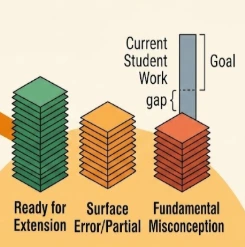
Analyze the gap
Sort responses fast — Ready for Extension, Surface Error, Fundamental Misconception.

Adapt instruction
Use the pattern to decide tomorrow's move instead of re-teaching what most students already know.
✽ The heart of the workshop
Four archetypes,
four cognitive goals
Error Analysis
Students examine flawed work — like taking only the positive square root, or a scale-factor mix-up — and identify the error type. It surfaces reasoning, not just answers.
Build the prompt straight from the misconceptions list already in your curriculum.
Concept vs. Computation
Separates procedural fluency from conceptual understanding Identifies who can compute an answer but can't say why it works.
Scan for items that demand deeper understanding and use those as your re-teaching source.
Self-Assessment / Traffic Light
A green/yellow/red confidence check that reduces math anxiety, gives every learner an equitable, anonymous voice, and informs next-day grouping.
Clarity is kindness — Focus by stripping unnecessary vocabulary so you isolate the real target.
3-2-1 Summary
Three steps, two lingering questions, one real-world connection — one prompt that captures multiple cognitive levels at once and drives metacognitive awareness.
Vary the three questions — e.g. "3 things that don't work, 2 that could, 1 that makes it easy."
Success criteria for the session
What teachers leave with.
Name the cognitive goal
Investigation into evaluation, understanding, efficacy, metacognition — for each of the four archetypes.
Design
Build at least one exit-ticket prompt aligned to a real objective in their own content.
Explain
Explore why the data matters and exactly how they'll use it through the 3-Pile Sort.
Identify
Discuss one or two implementation barriers — and a practical solution for each.
Commit
Identify your "Math Hill" for the next unit and plan a low-stakes formative assessment routine.
Take home
Receive a digital copy of toolkit reference card set with all four archetypes and pro tips on one side.
Built for secondary math teams
Designed for the courses where formative data changes instruction most.
Algebra 1 Algebra 2 Geometry Algebraic Reasoning Math Models Precalculus Calculus
Follow-up & extension
- Email follow-up within one week: 3-Pile Sort tips and sample Algebra 2 & Geometry tickets.
- Optional 1-hour virtual office hours for designing Hill-specific exit tickets.
- Bring a student work sample to your next PLC for collaborative analysis.
Session at a glance

Format
In-person workshop
Facilitator
David Henson, CAO
Mode
Hands-on & generative
Duration
3 hours (180 min)
Bold Math Solutions LLC
Take-home
Exit Toolkit reference cards
"Exit tickets aren't busy work."
They're your best opportunity to close the loop.
Bring Ticket to Success to your campus or district and give your math team a formative assessment routine that respects their time and sharpens their instruction.