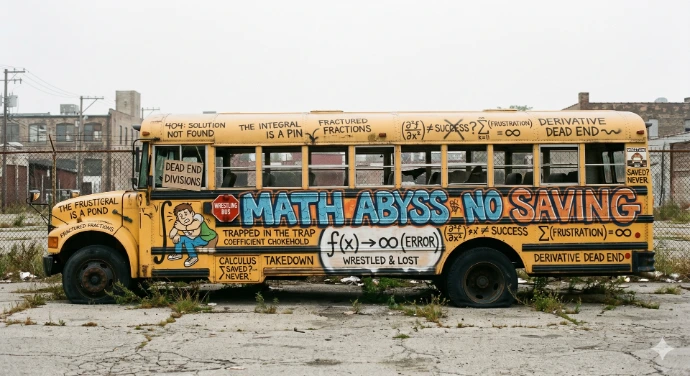
No Math Gets Saved From the Wrestling Bus
Blog from the Bus
Where Curiosity Meets Strategy in the Classroom
Welcome to a blog series designed for the modern educator who views the classroom not as a lecture hall, but as a playing field. No Math Gets Saved From the Wrestling Bus isn't just about "best practices"—it’s about analyzing the landscape of learning, understanding the "math wrestlers" (our students), and drafting strategies that actually stick.
Scouting Report:
CRA Conceptual Learning Model
by David Henson
July 2026
If experience is the best teacher, CRA is the mathematical equivalent of, “Show me. Don’t just tell me.” Basically, students build understanding by touching the math, then visualizing the math, and finally symbolizing the math. By rejecting passive compliance and algorithmic shortcuts, this three-step framework protects the student-teacher bond and transforms the classroom into a space for genuine, student-led discovery. Rather than rushing to abstract formulas, CRA embraces the "state of doubt," allowing resilient problem-solvers to build deep conceptual understanding naturally.
Enter the Bus Here
Past Blogs
This blog post argues that the term "productive struggle" has a branding problem because it inadvertently invites well-intentioned teachers to rescue students from the discomfort of learning. By rebranding the concept as "Math Wrestling," educators can shift the mindset from one of helpless frustration to one of determined independence where students actively fight to solve difficult problems.
Click Here
Drawing on a former wrestling coach's playbook, this article advocates for Explicit Instruction (EI) as a highly structured, teacher-led approach that breaks complex math into manageable chunks to build foundational procedural fluency. While highly scalable and effective for reducing cognitive overload—particularly for students with learning difficulties—the guide cautions that EI should be used strategically alongside inquiry-based methods to prevent student dependency and passive mimicking.
Click Here
Relying on "just do" shortcuts and procedural math tricks shifts the classroom focus from deep conceptual understanding to passive compliance, ultimately crushing student curiosity and creativity. To protect the student-teacher bond and foster resilient problem-solvers, educators must move away from these authoritative shortcuts and instead embrace the "state of doubt" that drives genuine, student-led discovery.
Click Here
If experience is the best teacher, CRA is the mathematical equivalent of, “Show me. Don’t just tell me.” Basically, students build understanding by touching the math, then visualizing the math, and finally symbolizing the math. By rejecting passive compliance and algorithmic shortcuts, this three-step framework protects the student-teacher bond and transforms the classroom into a space for genuine, student-led discovery. Rather than rushing to abstract formulas, CRA embraces the "state of doubt," allowing resilient problem-solvers to build deep conceptual understanding naturally.
Click Here
Pedagogy: A Wrestling Coach’s Approach
For 15 years, I had the privilege of coaching high school wrestling. I discovered that true mastery isn’t about "telling" a technique—it’s about "framing" moves as a strategic response. I realized I had to coach the context before I could coach the response. Basically, I became a Piaget Constructivist on the mat long before I ever encountered the formal term in a textbook. After seeing my athletes thrive by building their own situational understanding, I brought that same playbook into the classroom. I didn't just teach formulas; I became a math coach.
At the heart of this blog series is a firm commitment to Engagement. I believe that learners don't just passively absorb information; they actively construct knowledge by filtering new experiences through the lens of what they already know. In my view, the most profound learning happens when students are "doing" rather than "viewing." According to Lev Vygotsky, who emphasized the importance of social interaction and the Zone of Proximal Development (ZPD)—that sweet spot where a student can succeed with just the right amount of guidance (Vygotsky, 1978).
References
Vygotsky, L. S. (1978). Mind in Society: The Development of Higher Psychological Processes.